The Platform Dependency Question Every Serious Operator Eventually Has to Answer
It usually doesn't arrive as a crisis. It arrives quietly, somewhere around year three or four, on a Tuesday morning when you're reviewing your annual numbers with a clearer eye than usual. The commissions are larger than you remember them being. There was that week in February — peak Aspen ski season, $28,000 per night, fully bookable — that the algorithm deprioritized your listing because you hadn't refreshed your calendar in eleven days. There was the competitor dispute that put your account under review for six weeks over the summer, during a period when your Hamptons property should have been generating its highest revenues of the year. And then there is the thing that is harder to quantify but impossible to ignore once you see it: the guest who has stayed with you three times in four years, who has referred two other families, who spent $180,000 at your property over that period — and whose contact information you do not own, cannot access, and are not permitted to use without routing through the platform that introduced you.
The question arrives, quietly: what would happen if I owned this relationship directly?
In almost every case, the answer is transformative. The operators who get there faster build more defensible businesses. The ones who wait are, in the meantime, funding the infrastructure of the platform that controls their access to their own guests.
The Real Cost of Platform Dependency
Airbnb's standard host commission sounds, in isolation, entirely reasonable. Three percent. On a $500-per-night listing, that's $15. Manageable. Unremarkable. Easy to accept as a cost of distribution and move on.
On a property generating $1.2 million in annual booking revenue, that same 3% is $36,000. Every year. Gone to a platform that, in exchange for that $36,000, retains ownership of your guest data, controls your search visibility, sets the terms by which you can communicate with guests before and after their stay, and reserves the right to adjust its algorithm, its fee structure, or its review policies at any time, with or without your input.
That is before you account for Airbnb's guest-side service fee — typically 14% to 16% on top of the nightly rate — which compresses the perceived value of your property without you seeing any of it, and which conditions high-net-worth guests to anchor their price sensitivity to a platform-inflated total rather than your actual rate.
But the commission is not the deepest cost. The deepest cost is the relationship cost — and it compounds in a way that is almost impossible to recover from if you wait too long to address it.
Every guest who books through a third-party platform is, in the technical and legal sense, the platform's guest. The data belongs to them. The relationship, such as it exists in any structured form, runs through their system. You cannot email a guest who stayed two summers ago with a private pre-season booking window. You cannot send a personal note to the family who celebrated a milestone anniversary at your Cabo property over New Year's and ask if they'd like to reserve the same week next year before it goes to the general market. You cannot build anything with those relationships — no loyalty, no referral architecture, no CRM that grows in value over time — without routing every touchpoint through a system that is explicitly designed to make guests loyal to the platform, not to you.
"I had a guest who had stayed five times over three years," says one operator managing a seven-bedroom estate in Turks and Caicos. "Extraordinary family. Never a single issue. When I finally launched our direct booking site and reached out through our own channel, they told me they had assumed we were just an Airbnb listing — they had no idea we were an actual brand with an identity beyond the platform. Five stays. And they didn't know who we were."
What a Direct Booking Website Actually Changes
The operational case for direct booking is well understood: lower commissions, more margin, greater pricing flexibility. These are real and they matter. But the more significant transformation is one that operators don't fully anticipate until they experience it — the brand transformation.
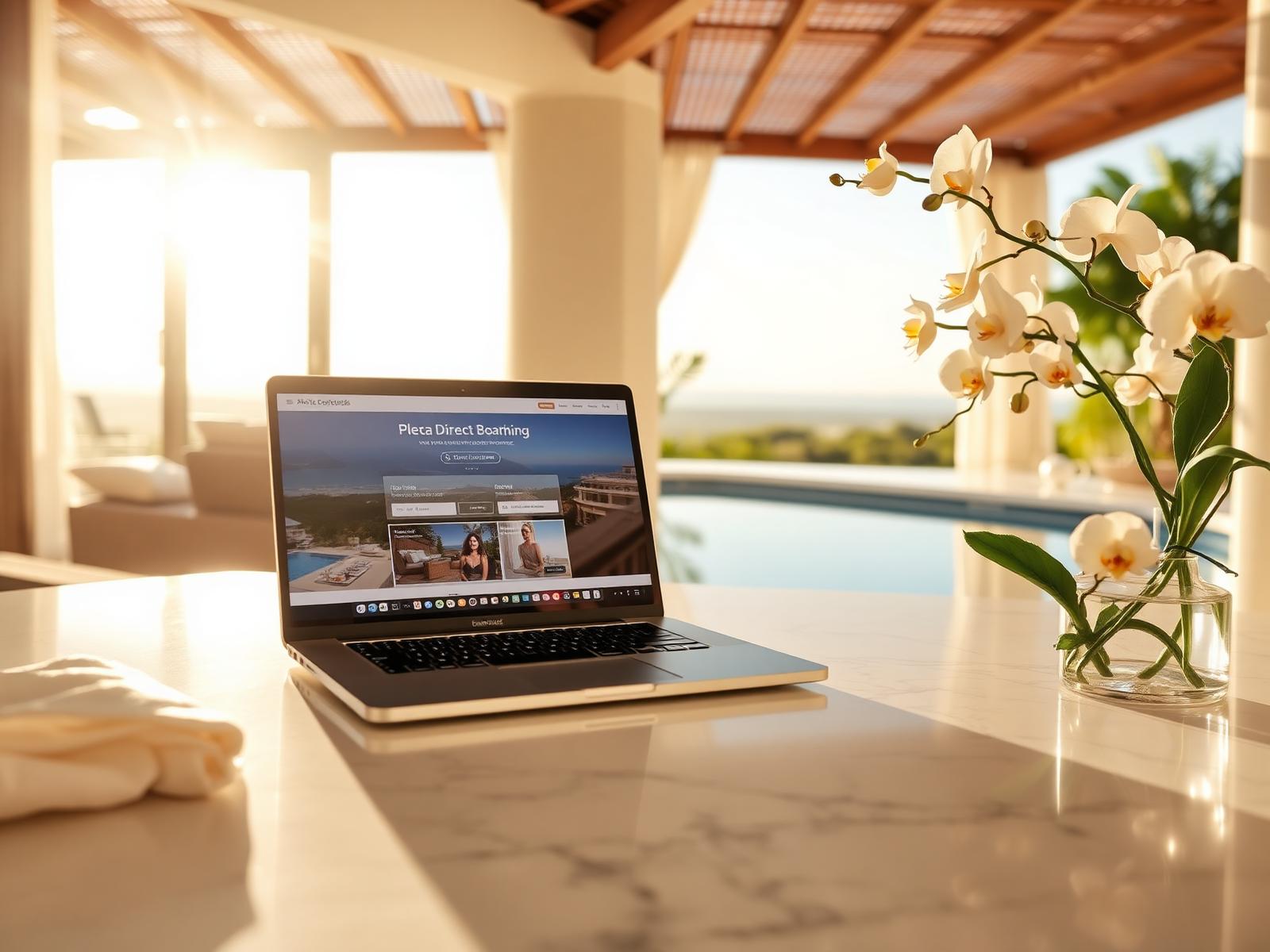
A guest who discovers your Aspen Christmas week through a custom direct booking website has a categorically different experience than a guest who finds the same property as item seventeen in an Airbnb search result. The former lands on a site built entirely around the specific extraordinary quality of what you offer — your photography, your story, the particular character of the property, the experience of what it is actually like to be there. The latter sees a standardized listing template that looks, structurally, identical to the listing immediately above and below it in the search results. One communicates a brand. The other communicates inventory.
This distinction shapes the entire guest relationship before a single message has been exchanged. Guests who arrive through a brand experience come with a different set of expectations — they understand they are booking something specific and exceptional, not competing on price for a commodity. They are more likely to book longer stays. They are more likely to request concierge services and ancillary experiences that increase total revenue per stay. And they are significantly more likely to become repeat guests, because their loyalty is attached to the property and the people running it, not to a platform that will show them an algorithmically superior alternative the moment they open the app.
The Search Behavior Nobody Is Talking About
There is a behavioral reality about how high-net-worth travelers actually plan ultra-luxury trips that most operators are entirely failing to capitalize on. They do not open Airbnb first. They search Google.
"Luxury villa rental Aspen Christmas," "private estate Cabo New Year's Eve," "beachfront compound Turks and Caicos March" — these are real search queries, entered in real volume, by real guests who have already made the decision to book something extraordinary. They are not browsing the platform marketplace looking for deals. They are looking for specific options, researching them deliberately, and making decisions based on which properties present themselves as brands worth trusting with a $50,000 booking.
A property with a well-built, SEO-optimized direct booking website is present for those searches. A property that exists only as an Airbnb listing is not — or rather, it is present only through Airbnb's own domain authority, which means any guest who finds it through search is still a platform guest, not a direct guest, and the operator captures none of the relationship value.
The window to build meaningful organic search presence has not closed, but it is narrowing. In mature luxury destination markets — the Hamptons, Aspen, Cabo, Palm Beach, Tuscany — the operators who built direct booking infrastructure four and five years ago have compounding advantages in domain authority, review volume, and repeat guest rates that will be genuinely difficult to close. The ones building now are still early enough to matter. The ones waiting another two or three years are building on sand.
A Case Study in the Difference It Makes
In early 2023, a husband-and-wife team operating two ultra-luxury properties — a beachfront estate in Malibu and a ski compound in Park City — made the decision to launch a direct booking brand after four years of near-total platform dependency. Their annual combined revenue was approximately $1.8 million. Their guest return rate was 9%. Their commission outflow was north of $50,000 per year between Airbnb and VRBO. They had one guest's direct email address.
Over the following eighteen months, they built a direct booking website, implemented a guest CRM with automated pre- and post-stay sequences, and launched a private booking window for past guests before each season opened to the public. They did not abandon the platforms entirely — both properties remained listed — but they repositioned the platforms as discovery channels rather than relationship channels, with a consistent off-platform follow-up strategy that moved inquirers and first-time guests into their owned ecosystem.
By the end of 2024, their direct booking share had moved from 4% to 41% of total revenue. Their average direct booking ADR was 19% higher than equivalent platform bookings. Guest return rate climbed to 27%. Commission outflow dropped by $34,000 in a single year. And they had built a guest list of 340 contacts — real names, real email addresses, real relationships — that they owned entirely and could activate independently of any platform's algorithm.
They did not change the properties. They changed the infrastructure around them.
What 2026 Makes Necessary
The luxury short-term rental market is not getting simpler. Platform fee structures have increased. Algorithm opacity has increased. The cost of acquiring a new guest through third-party channels — whether measured in commissions paid or organic visibility lost to platform-favored listings — is higher than it has ever been. And the guests at the top of the market, the ones booking $25,000-per-night estates for a week in Cabo over New Year's or a full Christmas week in Aspen, are more sophisticated consumers of online information than they have ever been. They research. They compare. They make booking decisions based on the totality of what a property's digital presence communicates about what it is and whether it can be trusted.
A custom direct booking website, in 2026, is not a marketing upgrade. It is table stakes for any operator who intends to build a durable luxury rental business rather than a platform-dependent revenue stream that can be disrupted by an algorithm change on a Tuesday morning.
The operators who understand this — who have already made the infrastructure investment and are now compounding the returns of owned guest relationships, organic search presence, and repeat booking rates that platform-dependent operators cannot touch — are not doing anything mysterious. They are simply operating with a longer time horizon. They are building brands, not listings.
The question of whether to own the relationship is one every serious operator eventually reaches. The only real variable is how long it takes you to answer it.
Estate Presence builds direct booking infrastructure for luxury and ultra-luxury short-term rental operators — custom websites, guest CRM, SEO, and the full owned-channel stack. If you are ready to stop renting your guests from Airbnb, schedule a strategy call.