The luxury short-term rental industry has produced some of the finest private hospitality experiences on earth. Almost none of them have a brand. That is the problem Estate Presence was built to solve.
There is a property in the hills above Cabo San Lucas — architect-designed, eleven bedrooms, an infinity pool that appears to dissolve directly into the Sea of Cortez. The photography is extraordinary. The guest reviews read like letters from people who experienced something genuinely life-changing. A family celebrating a patriarch's eightieth birthday. A group of longtime friends reuniting after years on different continents. A couple who quietly renewed their vows there at sunrise, just the two of them, because the place felt like it deserved that kind of moment.
The property generates somewhere in the range of $2.5 million per year in rental revenue. It has been written about, photographed, and shared across the networks of the high-net-worth families who have stayed there.
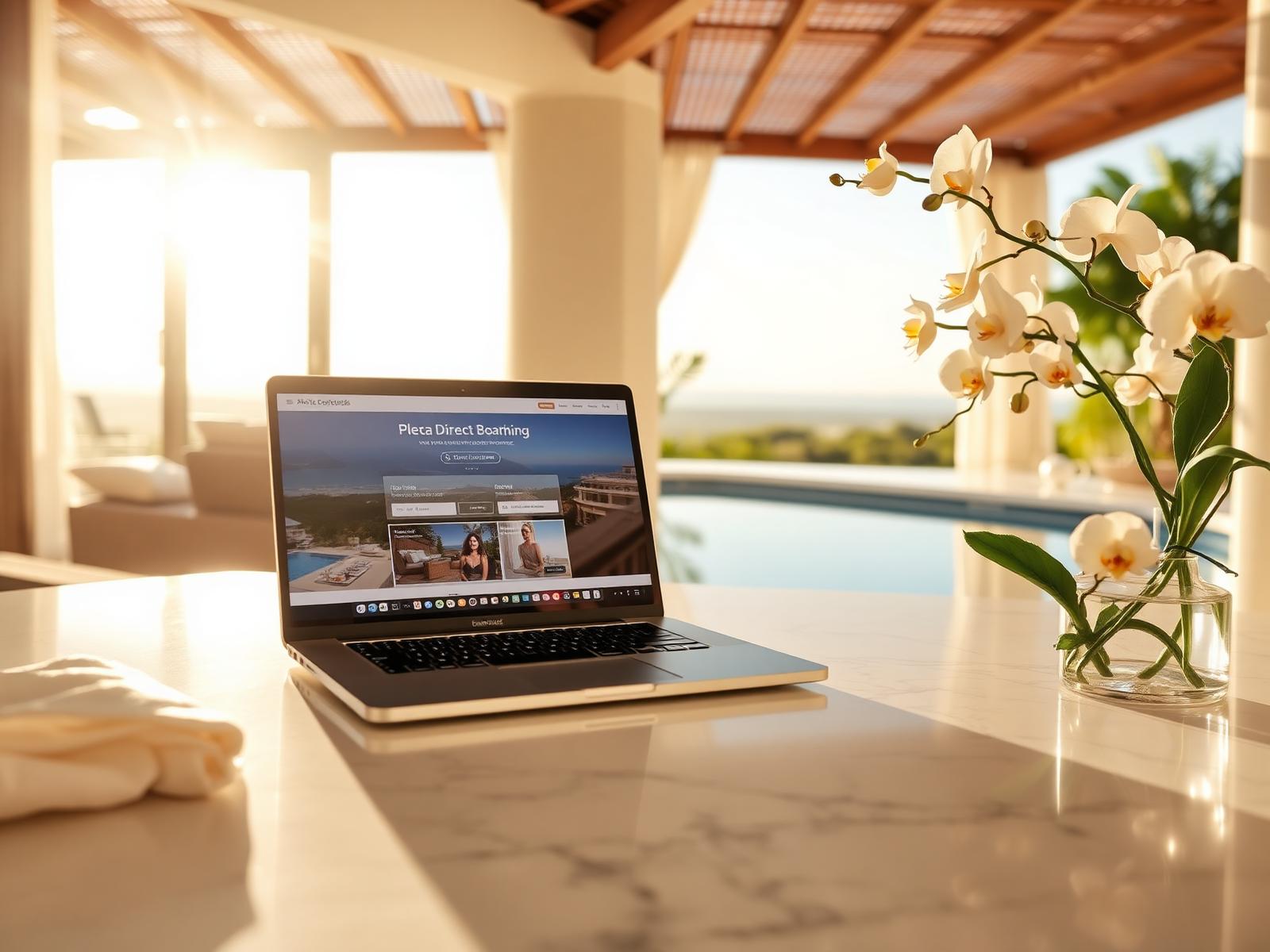
It has no brand. It has an Airbnb listing. It has a VRBO page. It has a basic website built on a template that is structurally and visually indistinguishable from several thousand other vacation rental websites. If you did not already know the property existed — if no one in your network had sent you the link — you would never find it. It would not occur to you to look for it. It communicates almost nothing about what it actually is.
This is not an unusual situation. It is, in our observation, the defining condition of the ultra-luxury short-term rental market. And it is the gap that Estate Presence was built to close.
An Industry That Built Extraordinary Products and Generic Brands
The luxury short-term rental industry has produced some of the finest private hospitality experiences anywhere in the world. Private estates that rival the experience of the best boutique hotels on earth. Architect-designed villas in Tuscany and the Amalfi Coast where the light through the windows at six in the morning is worth the entire cost of the trip. Oceanfront compounds on the North Shore of Kauai that exist in a category of beauty that commercial accommodation cannot approach, at any price. Mountain retreats in Aspen and Park City where a family of twenty can gather for Christmas week in a way that no hotel on the planet could replicate — the kitchen, the living room, the silence, the snow, the privacy of being entirely in your own space.
The physical product, in the best cases, is genuinely extraordinary.
And then there is the digital presence. The Airbnb listing with the same template layout as the studio apartment two blocks from the airport. The VRBO page where the property description was written by the owner on a Sunday afternoon and has not been touched since 2021. The website — if there is one — that communicates nothing in particular about why this specific place is worth $40,000 a week, why it is different from the seventeen other extraordinary properties in the consideration set, why the guest reading the page should feel something other than mild interest before clicking away to compare options.
The gap between the physical experience and the digital identity, in the luxury short-term rental market, is not small. It is profound. And it exists almost everywhere.
"I had a guest stay with us three times before she mentioned, almost in passing, that she had initially hesitated to book because our website looked like every other rental site she'd seen," says one operator managing an oceanfront estate in Punta Mita. "Three stays. Hundreds of thousands of dollars. And she almost didn't book the first time because our online presence didn't match what we actually were. That conversation was uncomfortable to sit with."
Why the Gap Exists
Understanding why the gap is so pervasive requires understanding how the luxury STR market actually developed. The industry grew largely bottom-up — individual property owners, investors, and managers building extraordinary physical assets and then listing them on the platforms that existed because the platforms were where guests were. Airbnb and VRBO solved a real distribution problem. They provided access to a market that otherwise required expensive traditional channels — travel agents, concierge networks, luxury rental agencies that took commissions in the 20% to 30% range.
The platforms worked. They still work, in the sense that they generate bookings. And the operators who built their businesses through them were, reasonably enough, focused on optimizing what the platforms rewarded: photography quality, review scores, response rates, Instant Book settings. The platform game was the game, and most operators played it with considerable sophistication.
What the platform game never required — what it actively discouraged, in some respects — was brand. The platform's interest is in the platform's brand, not yours. A guest who becomes loyal to a specific property is a guest who might eventually book that property directly, bypassing the commission entirely. The platform has no structural incentive to help you build an identity that transcends the listing. So it didn't. And most operators, busy running properties, never built one independently.
The result, across the industry, is a vast collection of extraordinary experiences packaged in generic containers.
What a Brand Actually Does for a Luxury Property
The word "brand" carries enough baggage that it is worth being precise about what it means in practice for an ultra-luxury short-term rental operation, and what it changes.
A brand is not a logo. It is not a color palette. It is not a tagline, though it may include all of these things. A brand is the cohesive, distinctive identity that allows a potential guest to understand, immediately and viscerally, what this property is — what it feels like, who it is for, and why it is categorically different from the alternatives they are considering.
When a family planning an Aspen Christmas week lands on a property website that has a genuine brand — consistent visual identity, photography that tells a story rather than cataloguing amenities, copy that speaks with a specific voice rather than generic superlatives, a booking experience that communicates care and exclusivity rather than self-service inventory — they are not comparing that property to other listings. They are deciding whether to commit to an experience. That is a fundamentally different purchasing psychology, and it converts at a fundamentally different rate.
"The properties that command the highest ADRs in any market are almost never the physically largest or most amenitized," says a luxury travel advisor who manages itineraries for family offices and C-suite executives across North America and Europe. "They are the ones that communicate a coherent identity. You know immediately what you are getting and why it costs what it costs. The properties that struggle to hold their rates are often objectively better — they just cannot communicate it."
This is the mechanism by which brand creates financial value that goes beyond aesthetics. A property with a clear, premium identity holds its rates through shoulder seasons because guests understand what they are paying for. It generates repeat bookings at higher rates because guests feel loyalty to an experience with a name and a face, not just a set of coordinates. It earns referrals more readily because guests can describe it — they have language for what it is. And it captures direct bookings from guests who search for it specifically, who arrived through a piece of content or a social channel or a word-of-mouth recommendation and went directly to the property's own website, bypassing platform commissions entirely.
The Case Study That Crystallized the Problem
In 2021, we worked with an operator managing a portfolio of four ultra-luxury villas across Tulum and the Riviera Maya. The properties were, by any objective measure, remarkable — designed by a notable Mexican architect, deeply integrated with the landscape, offering a specific and distinctive experience of the Caribbean coast that was genuinely difficult to find elsewhere.
Their combined annual revenue was approximately $1.9 million. Their Airbnb ratings were exceptional. And they had a 7% repeat guest rate, no direct booking infrastructure, and a brand presence that consisted of four separate, unrelated Airbnb listings with no connecting identity.
Over eighteen months, we built a unified brand — a name, a visual system, a website, and a content strategy — that positioned the portfolio as a coherent, distinctive luxury hospitality offering rather than four separate inventory items. The direct booking site launched with destination content, SEO infrastructure, and a guest CRM designed to convert platform guests into owned relationships.
By the end of 2023, their repeat guest rate had climbed to 29%. Direct bookings represented 38% of total revenue — up from effectively zero. Their average direct booking ADR was 17% above their platform equivalent, a premium that held across all four properties and all seasons. Total revenue had grown to approximately $2.7 million, an increase driven not by new properties or rate hikes but by the compounding economics of owned guest relationships and a brand that communicated what the portfolio had always been.
The properties did not change. What changed was the container.
The Observation That Built This Company
Estate Presence was built from a single observation, encountered again and again across property after property, market after market: the luxury short-term rental industry has produced experiences that are genuinely world-class, and has packaged almost all of them in a way that fails to communicate that.
That failure is not the fault of the operators. It is a structural artifact of how the industry developed and who the platforms were designed to serve. But it is consequential — in revenue, in guest quality, in the long-term defensibility of businesses that are built on extraordinary assets but operate with the fragility of platform dependency.
The gap — between what these properties actually are and how they present themselves to the world — is exactly where we live. Not to manufacture luxury where it doesn't exist. But to build the brand, the platform, and the team that allows extraordinary properties to be seen, understood, and valued as exactly what they are.
The Cabo estate with the infinity pool and the life-changing reviews deserves a presence that matches it. So does yours.
Estate Presence builds the brand infrastructure, direct booking platforms, and guest experience systems that ultra-luxury short-term rental properties deserve. Schedule a strategy call to see what that looks like for your property.